

Can you expand the size of a gold bangle? Yes — and in many cases, it can be done safely without compromising the design. Whether your bangle feels tight due to weight changes or sizing mistakes, professional gold bangle resizing methods such as stretching, adding gold, hinge insertion, or full redesign can help achieve a comfortable fit.
Before you decide to resize a gold bangle, it’s important to understand how the bangle’s design, thickness, and gold purity affect the resizing process. In this guide, we explain the safest and most effective ways to expand the size of a gold bangle so you can make an informed decision before visiting a jeweller.
Know Your Bangle Type First
Not all bangles can be resized the same way. Your jeweller will assess the construction before doing anything.
| Type | Resizing Ease | Notes |
| Solid gold | Easy ✓ | Best candidate — handles stretching and cutting well. |
| Hollow | Risky ✗ | Thin walls can dent or crack. Many jewellers won’t attempt it. |
| Hinged | Limited ~ | The hinge can’t be stretched, but other sections may be adjustable. |
| GOLD PURITY MATTERS TOO
Higher karat gold (24k gold) is softer and stretches more easily. Lower karat pieces contain more alloy metals, making them harder to work with. |
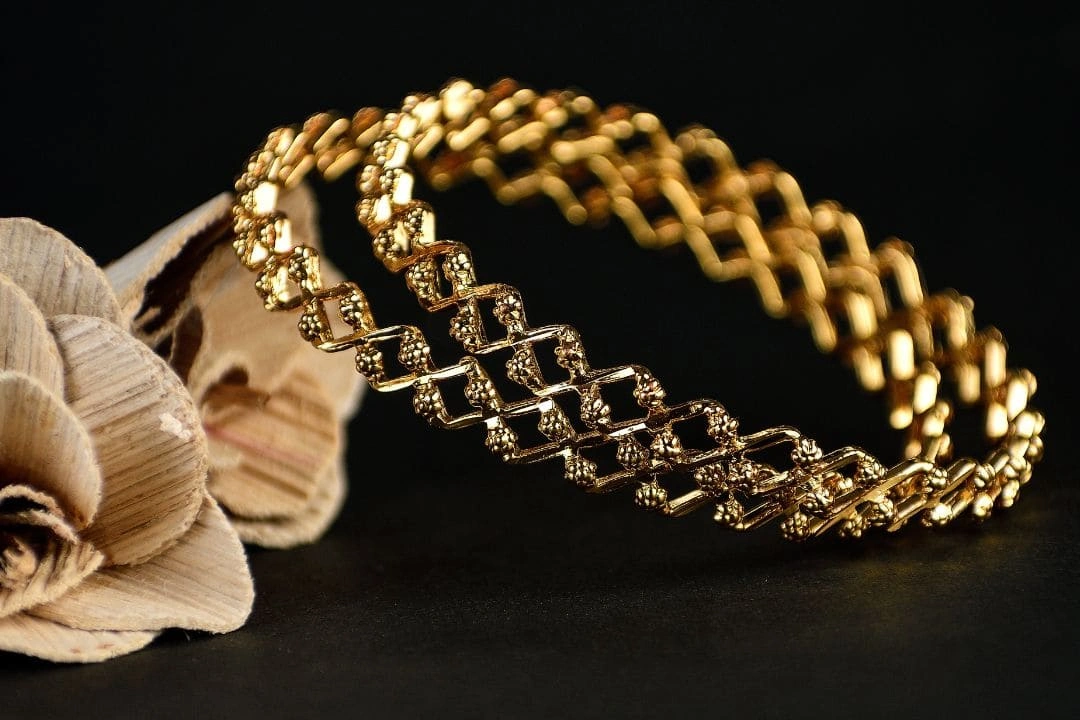
Method 1: Stretching (Minor Adjustments)
Best for solid bangles that need only a small increase in size.
How it works
- A jeweller slides the bangle onto a tapered steel mandrel (a cone-shaped tool).
- They tap it gently downward with a soft mallet, gradually expanding the circumference.
- The process takes 30–60 minutes and requires even, careful force throughout.
| IMPORTANT LIMIT
Stretching should only expand a bangle by about 1–2mm in diameter. Going further thins the metal and creates weak spots that can crack during everyday wear. |
Method 2: Cutting & Adding Gold (Bigger Changes)
If you need a more significant size increase, your jeweller will cut the bangle and insert extra gold.
How it works
- The bangle is cut at the back — the least visible point during wear.
- A matching gold insert is crafted to fit the gap, matched to the original profile, finish, and colour.
- The insert is welded or soldered into place.
Laser welding vs. traditional soldering
- Laser welding: Fuses gold molecules together — stronger, virtually invisible, and colour-consistent. Best for valuable pieces.
- Traditional soldering: Uses a lower-melting-point metal — effective but may show slight colour differences over time.
Method 3: Convert to a Hinged or Open Cuff
Sometimes the smartest solution is redesigning the bangle entirely.
Hinged conversion
- The bangle is cut and fitted with a hinge on one side, clasp on the other.
- It opens for easy wearing — no squeezing over the hand needed.
- Many wearers actually prefer this style, especially when wearing multiple bangles.
Open cuff conversion
- Both ends are left free — the bangle slips onto the wrist from the side.
- Works best for simple designs where a gap won’t disrupt any pattern or engraving.
Watch Out: Intricate Designs Need Extra Care
Gemstones
- Heat-sensitive stones — opals, pearls, emeralds — may need to be removed before any resizing work.
- Stretching can loosen settings and cause stones to fall out.
Engravings & hallmarks
- Stretching can distort hallmarks; cutting may remove them entirely.
- Personal engravings can often be worked around — or re-engraved afterwards — but plan this in advance.
| ALWAYS ASK UPFRONT
Tell your jeweller about any engravings, hallmarks, or stones before work begins. A good jeweller will factor these into their approach — or advise against resizing if the risks are too high. |
Not Ready to Resize? Try These First
Before committing to permanent modification, consider these alternatives:
- Bangle extenders — decorative chains that bridge a gap, adding wearable length without altering the original piece.
- Professional polishing — removes a thin outer layer, very slightly reducing thickness and improving comfort.
- Display it — if the bangle is purely sentimental, a shadow box or jewellery display case preserves it beautifully for future generations.





Article
How Can We Expand the Size of a Gold Bangle?